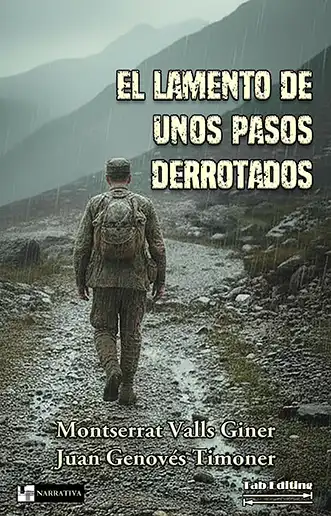
Novel El Lamento De Unos Pasos Derrotados
4,50 € IVA incluido
Synopsis of: El Lamento de Unos Pasos Derrotados (written in Spanish)
El Lamento de Unos Pasos Derrotados: Historical Fiction
If you prefer to purchase the English version of “The Lament of Defeated Footseps,” click here.
Basic Information
Title: El Lamento de Unos Pasos Derrotados
Authors: Montserrat Valls Giner and Juan Genovés Timoner
Genre: Historical novel / Social fiction
Main setting: Barcelona, France, and the Argelès-sur-Mer camp
Narrative period: From 1932 to 1954, with particular emphasis on the Spanish Civil War and the post-war years
General Summary
The novel tells the story of Francisco and Mercedes over more than twenty years, in a context marked by political instability, the Spanish Civil War, exile, Francoist repression, and the harsh post-war period. Begins the story with Francisco fleeing to France after the Republican defeat, as he reminisces about his love for Mercedes and the events that brought them together. From there, the novel alternates between scenes from the present and numerous flashbacks, reconstructing the evolution of their relationship: their wedding, the war, their separation, their exile, their return, and their subsequent family life.
One of the novel’s central themes is survival: surviving hunger, fear, war, illness, and loss. Francisco manages to reach France, but there he endures the inhumane conditions of the Argelès-sur-Mer camp. Mercedes, meanwhile, survives in Barcelona as best she can, working, enduring extreme hardship, and waiting for news of her husband. Later, the couple reunites and rebuilds their lives, though the war leaves a profound mark on both of them.
The second major narrative thread is family life: the birth of his children, the upbringing of Libertad and Joaquín, financial difficulties, work, living with his in-laws, and the importance of solidarity among neighbours and family. The novel ends with a sense of continuity and hope, though without concealing the weight of memory and the suffering endured.
Electronic edition
PROMOTIONAL FRAGMENT (in Spanish)
IMPORTANT: Once you unzip the file that you will download, select the format that best suits you:
EPUB, for most readers and for Adobe Digital Editions
MOBI, for Kindle applications and readers
If you prefer to purchase the softcover printed version, CLICK HERE
If you prefer to purchase the hardcover printed version, CLICK HERE
Description
Synopsis of: El Lamento de Unos Pasos Derrotados (written in Spanish)
El Lamento de Unos Pasos Derrotados: Historical Fiction
If you prefer to purchase the English version of “The Lament of Defeated Footseps,” click here.
Basic Information
Title: El Lamento de Unos Pasos Derrotados
Authors: Montserrat Valls Giner and Juan Genovés Timoner
Genre: Historical novel / Social fiction
Main setting: Barcelona, France, and the Argelès-sur-Mer camp
Narrative period: From 1932 to 1954, with particular emphasis on the Spanish Civil War and the post-war years
General Summary
The novel tells the story of Francisco and Mercedes over more than twenty years, in a context marked by political instability, the Spanish Civil War, exile, Francoist repression, and the harsh post-war period. Begins the story with Francisco fleeing to France after the Republican defeat, as he reminisces about his love for Mercedes and the events that brought them together. From there, the novel alternates between scenes from the present and numerous flashbacks, reconstructing the evolution of their relationship: their wedding, the war, their separation, their exile, their return, and their subsequent family life.
One of the novel’s central themes is survival: surviving hunger, fear, war, illness, and loss. Francisco manages to reach France, but there he endures the inhumane conditions of the Argelès-sur-Mer camp. Mercedes, meanwhile, survives in Barcelona as best she can, working, enduring extreme hardship, and waiting for news of her husband. Later, the couple reunites and rebuilds their lives, though the war leaves a profound mark on both of them.
The second major narrative thread is family life: the birth of his children, the upbringing of Libertad and Joaquín, financial difficulties, work, living with his in-laws, and the importance of solidarity among neighbours and family. The novel ends with a sense of continuity and hope, though without concealing the weight of memory and the suffering endured.
Plot Summary
Francisco, defeated after the Civil War, flees to France in 1938. During his journey, he recalls his love story with Mercedes, whom he met in 1932. The novel then flashes back to show how they fell in love, how they married in 1935, and how the war shattered their plans. Francisco participates in the Battle of the Ebro and, after the Republican defeat, decides to escape to save his life.
Mercedes receives news of him through Gabriel, a man who delivers a letter. In this letter, Francisco explains that he is heading to France and hopes to be reunited with her. Meanwhile, Mercedes survives in Barcelona in poverty, working and relying on her family for support.
France
Francisco arrives in France, but there he is interned in the Argelès-sur-Mer camp, where he suffers hunger, cold, and illness. Before arriving in France, he had met Gaietà, a kind farmer who took him in for a time and helped him stay alive. Thanks to him, Francisco managed to send news to Mercedes.
Sometime later, nearly dead, he returns to Barcelona when the situation allows, with the help of the Red Cross and without knowing for sure if anyone intervened on his behalf.
Back home, the couple resumes their life. They have two children, Libertad and Joaquín, and face new difficulties: Mercedes’ postpartum depression, raising the children, financial hardship, and the pressure of the Franco regime. Mercedes is eventually admitted to a mental institution and undergoes electroshock therapy, a particularly harrowing part of the novel. Finally, she recovers and returns home.
The story closes with a more serene vision: the family has survived, the children grow up, and the memory of what they experienced becomes a moral and political warning. The epilogue emphasizes the importance of freedom and the duty to remember those who fought for it.
Main Characters
Francisco
He is the male protagonist. Francisco represents the Republican man: sensitive, hardworking, and deeply humane. He experiences the war as an absurd tragedy and suffers exile, hunger, and humiliation. Despite everything, he retains hope and his love for Mercedes as the driving force in his life.
Mercedes
She is the female protagonist. Strong, loving, and resilient, she endures war, poverty, and motherhood with immense dignity. Her postpartum depression and her admission to the sanatorium reveal the psychological fragility that war and misery can leave behind. She is a very human and complex character.
Libertad
The couple’s eldest daughter. Her name symbolizes a moral and political aspiration. Throughout the novel, she transitions from girl to teenager, and her growth also reflects the family’s recovery and a certain openness toward the future.
Joaquín
Youngest son. He is a very bright, curious, and precocious child. His intelligence and ease of learning bring a tone of hope. He also serves to illustrate education in the post-war period and the transmission of values.
Gaietà
A peasant who takes Francisco into the farmhouse. He is one of the noblest characters in the novel. He represents solidarity, kindness, and humanity amidst disaster.
Tomasa, Joaquina, Joaquín, Leandro, and other secondary characters
They all form the family and social network that sustains the protagonists. Some contribute ideological tension, others material or emotional support. Leandro, for example, embodies the political conflict within the family itself.
Main Themes
War as Destruction
The novel presents war not as an epic, but as a machine of physical and moral destruction. There is hunger, fear, death, exile, repression, and psychological trauma.
Love as Refuge
The relationship between Francisco and Mercedes is the emotional heart of the work. Love gives them the strength to resist, to hope, and to rebuild their lives.
Memory
The novel is built upon memories. The past constantly returns to explain the present. Remembering is a way to resist oblivion and to give meaning to suffering.
Family and Solidarity
The family is not presented as an idealized space, but as a real support network. Brothers-in-law, mothers, neighbours, and friends help them survive.
Poverty and Dignity
The work depicts the everyday misery of war and the post-war period: scarce food, patched-up clothing, precarious housing, and poorly paid jobs. However, the characters retain their dignity.
Freedom
The title and the daughter’s name allude to this theme. Freedom appears as a political ideal, but also as an intimate and human need.
Structure and Style
The novel is organized into chronological chapters, although with frequent time jumps and flashbacks. This structure allows for comparisons between the painful present and the happy or hopeful past.
The style is highly descriptive and emotional, with an abundance of everyday details, historical references, and colloquial expressions. There is also a strong documentary component: dates, places, foods, customs, and real historical events are mentioned.
Another important feature is the use of explanatory footnotes, which clarify Catalan words, dishes, expressions, and historical references. This gives the work an almost testimonial tone.
It is a very moving and committed novel because it combines the intimate story of a family with the broader history of Spain and Europe. Its most valuable aspect is that it does not romanticize suffering: it shows how war and the post-war period affect daily life, mental health, food, work, and family relationships.
It also stands out for its ability to convey tenderness amidst the harshness. There are scenes of enormous brutality, but also moments of humour, affection, and hope. This makes the reading experience human and relatable.
Overall, it is a work that invites reflection on historical memory, the fragility of peace, and the importance of solidarity. Its final message is clear: freedom and dignity are not gifts, but hard-won achievements that must be protected.
Electronic edition
PROMOTIONAL FRAGMENT (in Spanish)
IMPORTANT: Once you unzip the file that you will download, select the format that best suits you:
EPUB, for most readers and for Adobe Digital Editions
MOBI, for Kindle applications and readers
If you prefer to purchase the softcover printed version, CLICK HERE
If you prefer to purchase the hardcover printed version, CLICK HERE
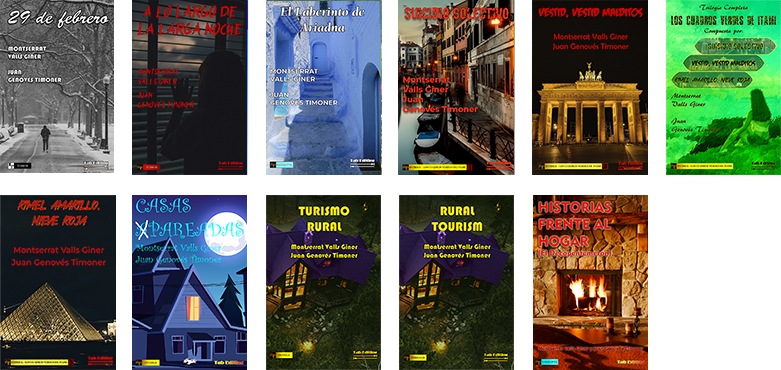
PUBLISHED BOOKS (in Spanish):
Read our news and informations in our BLOG OF STORIES AND NEWS